
Chinese Sentence Structure Basics: Complete Beginner's Guide
Key Takeaway:
Chinese sentence structure is deceptively straightforward–no conjugations or tenses to worry about! Simply clear word order patterns. Learn the five essential structures every beginner must know with this comprehensive guide.
Chinese sentence structure scares a lot of beginners. But here's the truth: Chinese grammar is actually simpler than English—no verb conjugations, no tenses, no plural forms. Once you learn the basic word order patterns, you can start making sentences immediately.
In this guide, I'll show you the 5 essential sentence structures every Chinese learner needs to know.
Why Chinese Sentence Structure Is Simpler Than You Think
Unlike English, Chinese doesn't change words based on tense or subject:
- ✅ I eat = 我吃
- ✅ He eats = 他吃 (no “s" added!)
- ✅ I ate = 我吃了 (just add 了)
- ✅ I will eat = 我会吃 (add 会)
The word “吃" (eat) never changes. You just add particles or auxiliary words to show time or aspect.
Before diving deeper, make sure you have a strong foundation. Check out my complete beginner's guide to learning Chinese if you're just starting out.
The Basic Pattern: Subject + Verb + Object
The most common Chinese sentence structure is:
Subject + Verb + Object (SVO)
This is the SAME as English!
Examples:
| Chinese | Pinyin | English |
|---|---|---|
| 我喜欢中文 | Wǒ xǐhuan zhōngwén | I like Chinese |
| 他吃苹果 | Tā chī píngguǒ | He eats apples |
| 我们学习中文 | Wǒmen xuéxí zhōngwén | We study Chinese |
| 她看书 | Tā kàn shū | She reads books |
Key point: Chinese word order for basic sentences is almost identical to English!
Adding Time and Place
Here's where Chinese differs from English. Time and place come BEFORE the verb:
Pattern: Subject + Time + Place + Verb + Object
Time Comes Before the Verb:
| Chinese | Pinyin | English |
|---|---|---|
| 我明天去北京 | Wǒ míngtiān qù Běijīng | I go to Beijing tomorrow |
| 他昨天吃了饭 | Tā zuótiān chī le fàn | He ate rice yesterday |
| 我们今天学中文 | Wǒmen jīntiān xué zhōngwén | We study Chinese today |
Place Also Comes Before the Verb:
| Chinese | Pinyin | English |
|---|---|---|
| 我在家吃饭 | Wǒ zài jiā chī fàn | I eat at home |
| 他在学校学习 | Tā zài xuéxiào xuéxí | He studies at school |
| 她在北京工作 | Tā zài Běijīng gōngzuò | She works in Beijing |
Combining Time and Place:
Pattern: Subject + Time + Place + Verb + Object
Example:
我明天 在家 吃饭
Wǒ míngtiān zài jiā chī fàn
I will eat at home tomorrow
Notice: Time comes before place!
How to Form Questions
Chinese has THREE main ways to ask questions:
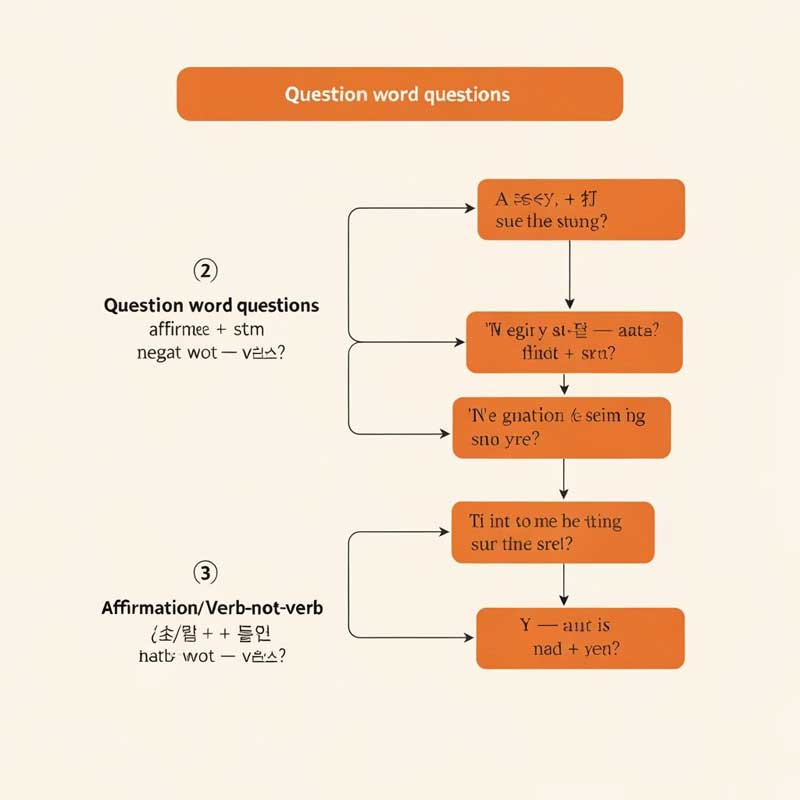
Method 1: Add 吗 (ma) at the End
The easiest way! Just add 吗 to any statement:
| Statement | Question |
|---|---|
| 你喜欢中文 (You like Chinese) | 你喜欢中文吗? (Do you like Chinese?) |
| 他是老师 (He is a teacher) | 他是老师吗? (Is he a teacher?) |
| 你去北京 (You go to Beijing) | 你去北京吗? (Do you go to Beijing?) |
Method 2: Use Question Words
Common question words:
- 什么 (shénme) = what
- 哪里/哪儿 (nǎlǐ/nǎr) = where
- 谁 (shéi) = who
- 什么时候 (shénme shíhou) = when
- 怎么 (zěnme) = how
- 为什么 (wèishénme) = why
Examples:
| Chinese | Pinyin | English |
|---|---|---|
| 你叫什么? | Nǐ jiào shénme? | What is your name? |
| 你在哪里? | Nǐ zài nǎlǐ? | Where are you? |
| 谁是老师? | Shéi shì lǎoshī? | Who is the teacher? |
Struggling with pronunciation? Master your tones first with my complete guide to Chinese tones.
Method 3: Verb-Not-Verb Pattern
Repeat the verb with 不 (bù) in between:
| Chinese | Pinyin | English |
|---|---|---|
| 你去不去? | Nǐ qù bu qù? | Do you go or not? |
| 他是不是老师? | Tā shì bu shì lǎoshī? | Is he a teacher or not? |
| 你喜不喜欢中文? | Nǐ xǐ bu xǐhuan zhōngwén? | Do you like Chinese or not? |
Negation: Using 不 and 没
Chinese has two main negation words:
不 (bù) – For Present and Future
Use 不 before the verb:
| Chinese | Pinyin | English |
|---|---|---|
| 我不喜欢 | Wǒ bù xǐhuan | I don't like |
| 他不去 | Tā bù qù | He doesn't go |
| 我明天不工作 | Wǒ míngtiān bù gōngzuò | I won't work tomorrow |
没 (méi) – For Past Actions
Use 没 for things that didn't happen:
| Chinese | Pinyin | English |
|---|---|---|
| 我没吃饭 | Wǒ méi chī fàn | I didn't eat |
| 他没去 | Tā méi qù | He didn't go |
| 我没看电影 | Wǒ méi kàn diànyǐng | I didn't watch the movie |
Remember: 不 = present/future negation, 没 = past negation
5 Essential Sentence Patterns
Pattern 1: Describing Things (是 Sentences)
Structure: A + 是 + B
- 我是学生 (I am a student)
- 这是书 (This is a book)
- 他是老师 (He is a teacher)
Pattern 2: Describing States (Adjective Sentences)
Structure: Subject + 很 + Adjective
- 我很高兴 (I am happy)
- 天气很好 (The weather is good)
- 中文很难 (Chinese is difficult)
Note: Chinese uses 很 where English uses “is/am/are"
Pattern 3: Possession (有 Sentences)
Structure: Subject + 有 + Object
- 我有一本书 (I have a book)
- 他有一个朋友 (He has a friend)
- 我们有问题 (We have a question)
Pattern 4: Location (在 Sentences)
Structure: Subject + 在 + Place
- 我在家 (I am at home)
- 他在学校 (He is at school)
- 书在桌子上 (The book is on the table)
Pattern 5: Doing Things (Action Sentences)
Structure: Subject + Verb + Object
- 我学中文 (I study Chinese)
- 他吃饭 (He eats rice)
- 我们看电影 (We watch movies)
Important Word Order Rules
Rule 1: Time Before Place
❌ Wrong: 我在家明天吃饭
✅ Right: 我明天在家吃饭 (I will eat at home tomorrow)
Rule 2: Adverbs Before Verbs
Words like 也 (also), 都 (all), 很 (very) come before verbs:
❌ Wrong: 我去也
✅ Right: 我也去 (I also go)
Rule 3: Measure Words Between Numbers and Nouns
❌ Wrong: 一书
✅ Right: 一本书 (one book)
Want to master measure words? Check out my detailed guide on Chinese measure words.
Rule 4: Modifiers Before Nouns
Adjectives and possessives come before nouns:
- 我的书 (my book)
- 红色的苹果 (red apple)
- 很好的老师 (very good teacher)
Common Mistakes to Avoid
❌ Mistake #1: Putting Time After the Verb
Wrong: 我去北京明天
Right: 我明天去北京
❌ Mistake #2: Forgetting Measure Words
Wrong: 我有三狗
Right: 我有三只狗 (I have three dogs)
❌ Mistake #3: Using 是 with Adjectives
Wrong: 我是高兴
Right: 我很高兴 (I am happy)
❌ Mistake #4: Using 不 to Negate Past Actions
Wrong: 我不吃饭 (when you mean “I didn't eat")
Right: 我没吃饭
Practice Exercises
Exercise 1: Translate to Chinese
- I like Chinese food.
- He studies at home.
- We will go to Beijing tomorrow.
- She didn't eat breakfast.
- Are you a teacher?
Answers:
- 我喜欢中国菜 (Wǒ xǐhuan zhōngguó cài)
- 他在家学习 (Tā zài jiā xuéxí)
- 我们明天去北京 (Wǒmen míngtiān qù Běijīng)
- 她没吃早饭 (Tā méi chī zǎofàn)
- 你是老师吗? (Nǐ shì lǎoshī ma?)
Exercise 2: Fix the Mistakes
- 我去也 (I also go)
- 他在学校明天 (He will be at school tomorrow)
- 我是很高兴 (I am very happy)
- 你喜欢什么吗? (What do you like?)
Answers:
- 我也去
- 他明天在学校
- 我很高兴 (remove 是)
- 你喜欢什么? (remove 吗)
What to Learn Next
Now that you understand basic sentence structure, here's what to tackle next:
- Master particles: Learn when to use 了, 着, 过
- Study measure words: Choose the right classifier
- Practice speaking: Use these patterns in conversation
- Learn more complex structures: Compound sentences, comparisons
Want to practice these structures in real conversations? Read my guide on how to practice Chinese speaking alone.
Want to learn more simple phrase in Chinese? Read Beginners Should Learn These 10 Common Chinese Phrases
If you are preparing HSK test, kindly refer to HSK 1 Study Guide and HSK 3 vs HSK 4
Remember: Chinese sentence structure is logical and consistent. Master these basic patterns, and you'll be able to express almost anything! 🚀
🎯 Master Chinese Grammar with Expert Guidance
Understanding grammar rules is one thing—using them correctly in conversation is another. I'm Candice, and I specialize in helping students master Chinese grammar through practical, conversation-focused lessons.
In my lessons, you'll learn to:
- ✅ Build grammatically correct sentences naturally
- ✅ Use particles (了, 着, 过, 的) with confidence
- ✅ Avoid common grammar mistakes
- ✅ Apply grammar rules in real conversations
👉 Ready to speak grammatically correct Chinese? Explore my structured online lessons designed to take you from grammar theory to fluent speaking.
Curious about my teaching methods? Learn more about my background and approach to see how I can help you succeed.
Find the perfect lesson plan: Check out my affordable pricing packages for every learning style and budget.
Have questions? Contact me today and let's discuss how I can help you master Chinese grammar!
Which sentence pattern do you find hardest? Let me know in the comments!